
Narratives of change: women’s reflections on evolving productive roles in the Agar Dinka community
This issue brief examines the evolving productive roles of Agar Dinka women in South Sudan, in the context of increasing male absence due to conscription, conflict, and economic migration.
Publisher
SPARC
This issue brief examines the evolving productive roles of Agar Dinka women in South Sudan, in the context of increasing male absence due to conscription, conflict, and economic migration.
The study was conducted in January and February 2025 across four counties in Lakes State by the lead author and a team of local researchers. Drawing primarily on women’s firsthand accounts, the research explores four key themes:
- Women's traditional productive roles.
- Women's current productive roles.
- Drivers of change.
- The benefits and drawbacks of these changes.
Key findings include:
- Agar Dinka women have traditionally played vital roles in crop cultivation, livestock care, food management, and income generation. With the growing absence of men, women are increasingly taking on greater responsibilities, especially in rural areas where they often lead both farming and livestock activities.
- Displaced women in urban areas are assuming new roles in humanitarian work, wage labour, and small-scale enterprise.
- Younger women are more open to new opportunities, whereas older women often express concern about the erosion of traditional structures and support systems.
Policy implications include:
- The need for agriculture and livelihood-related policy processes in South Sudan to acknowledge and adapt to the changing roles of women.
- It is critical to engage women as active decision-makers, not merely as recipients or beneficiaries of policy interventions planned for men.
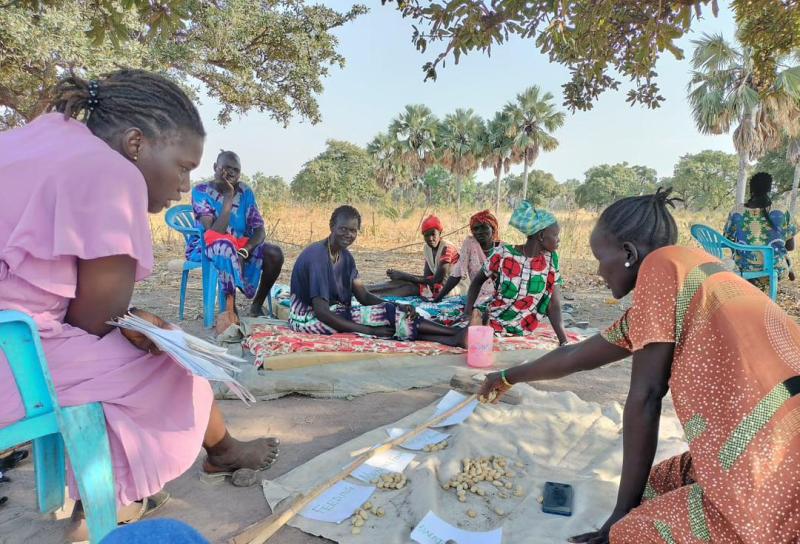
Proportional piling – a data collection method for quantifying women’s customary and contemporary roles – during a focus group discussion, Tumic Village, Rumbek Centre, 2025
Credit
© Elizabeth Nyibol Malou