Policy brief
How to manage crises differently in ASALs without talking about a nexus: what we can learn from the water sector
SPARC research on water development in the drylands reveals how a divide between development thinking and humanitarian action is undermining resilience and community trust.
Éditeur SPARC
We have known for decades that the international aid model for responding to emergencies does not work well where crises are frequent. Long-term development planning struggles to deal with crises, often leaving the responsibility to separate emergency interventions – but these short-term measures often undermine longerterm strategies. Various theoretical approaches have been proposed for addressing this fragmented situation, but with little success.
SPARC’s recent research on the provision of water in the arid and semi-arid lands (ASALs) of eastern Africa offers a different way of addressing the issue. By identifying the specific problems caused by the lack of integration between emergency water interventions and water development, sensible solutions can be found without getting bogged down in jargon around the development–water–peace ‘nexus’ or in resilience frameworks. This same approach offers more practical ways forward than the struggles that arise when the starting point is the architecture of emergency assistance rather than a shared responsibility for providing a reliable water supply.
Key messages
- Predictable crises must be factored into longer-term planning. Actors focusing on drought response and those focused on natural resource development need to agree in advance on who will finance what, and under which eventualities. All actors must respect the agreed strategy, and should only commit to arrangements they can realistically sustain.
- When installing or repairing water supplies, plan for maintenance and surge capacity. This includes having a clear system for financing increased demand during droughts. If there is no plan for this, the intervention should not proceed.
- Do not assume maintenance capacity exists elsewhere. Do not assume that another actor will be responsible for maintaining the water supply, or that this capacity already exists. Assume that it does not.
- Demand accountability for water source maintenance. Authority to collect fees cannot be devolved without clear accountability mechanisms.
- Water illustrates the need to integrate long- and short-term thinking. A “nexus” approach does not mean loosely coordinating separate activities, nor that every actor must address both short- and long-term priorities. It means agreeing on a shared strategy for reliable services and resources that incorporates potential crises — and respecting that strategy when crises occur.
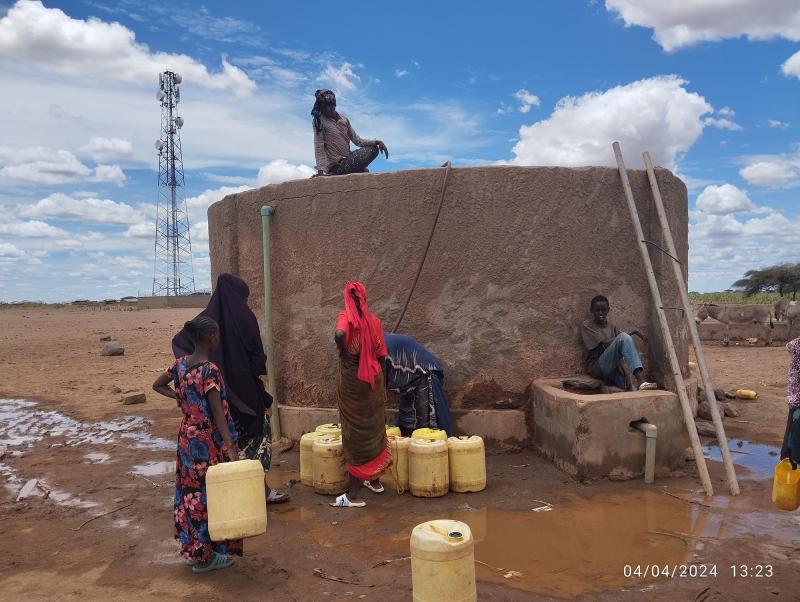
Collecting saline water at Bubisa, Marsabit County, Kenya.
Credit © Jackson Wachira, April 2024