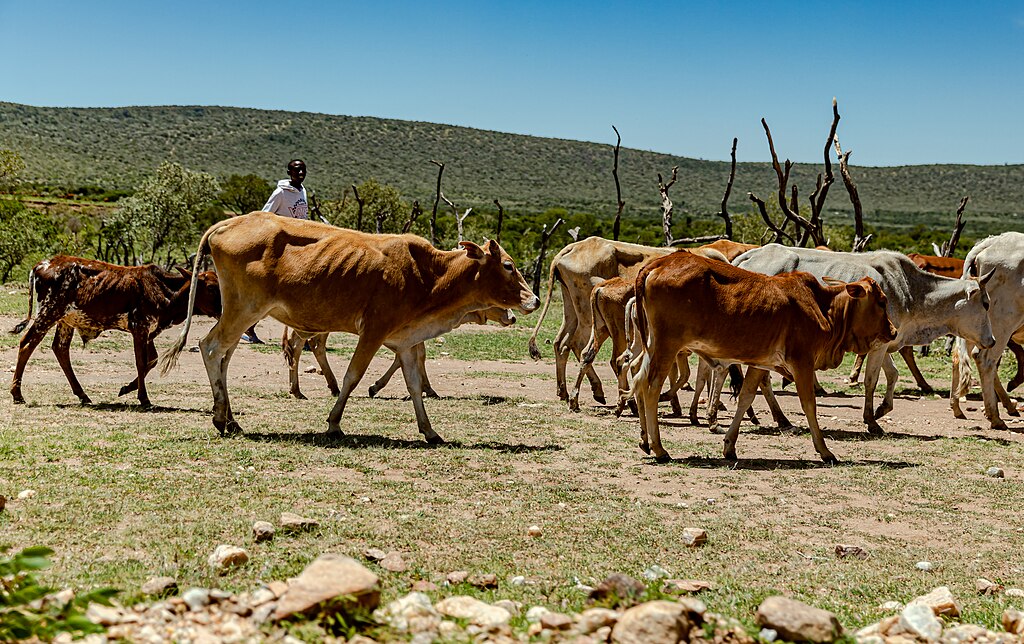
Supporting pastoralists through AfriScout Steward and Regen: Impact evaluation
This report evaluates AfriScout Steward, a digital app used in Kenya that provides crowd-sourced data on rangelands, and AfriScout Regen, an app that provides intensive grazing support in Ethiopia.
Rapid changes in East Africa’s arid and semi-arid regions, caused by climate-related disasters, armed conflict, livestock diseases, macroeconomic shocks, and increasing population, are making pastoralism increasingly precarious.
Innovations to enhance pastoralists’ resilience are needed.
To this end, Global Communities’ AfriScout programme supports pastoralists through two interventions. AfriScout Regen (in Ethiopia) provides direct technical support to communities. This support builds on and improves traditional grazing practices so that livestock movement promotes vegetation regeneration. AfriScout Steward (in Kenya), provides satellite and crowd-sourced information on rangeland conditions through a mobile phone app, to inform grazing and migration decisions.
SPARC partner Causal Design produced this report, with accompanying appendices, after carrying out a two-year, mixed-methods impact evaluation to identify the attributable outcomes of AfriScout on pastoralist decision-making and subsequent impacts on rangeland and herd conditions.
Findings
- AfriScout Regen had a large and statistically significant impact on almost all outcomes in targeted communities. There were significant shifts in rangeland management, with the establishment of shared grazing plans, rotational and communal grazing. Adherence to such plans led to significant improvements in rangeland conditions, subsequent improvements in herd condition, and other aspects of financial and non-financial wellbeing (e.g. confidence in decision making, less stress, equitable access to information).
- Pastoralists valued the AfriScout app and incorporated information from it into migration decisions. Findings on outcomes, however, were inconclusive. When interviewed, respondents reported positive outcomes on herd condition, and subsequent effects on financial, and non-financial wellbeing, which they attributed to use of the AfriScout app.
- Quantitative findings, however, did not confirm these reports. Lack of quantitative evidence may have been caused by contamination in the survey owing to the spread of app information from treated to control groups by word of mouth, as well as by uncharacteristically plentiful rain during the study.
Policy implications
Our results contribute novel insights into the effectiveness of digital tools for migration decisions and the impact of regenerative grazing practices in developing countries, while also highlighting critical implementation challenges such as information spillovers.
Our findings show the importance of tailoring interventions to local context, above all how pastoralists share information.
- For AfriScout Regen, we recommend further expanding the model to other areas, both to share the intervention’s positive effects with other communities, and to safeguard existing regenerative grazing units. Further investigation should be undertaken into access to water and veterinary services, and effects of Regen on gendered outcomes and livestock disease.
- For AfriScout Steward, we recommend additional app features or functionality, such as incorporating market information, and increased offline capabilities. Other recommendations include improving the user interface and incorporating additional training materials onto the app and in-built support such as video tutorials for use in the absence of Field Agents to provide troubleshooting support. Finally, we recommend identifying strategies to overcome constraints on real-time data sharing.
Policy makers should consider local context, tailoring interventions to ensure their success. They should also consider trade-offs between impact, scalability, and budget when designing interventions for pastoralists.