Policy brief
Adapting through bricolage: building resilience in northeast Nigeria
This policy brief explores how communities use the creative recombination of available resources, skills, and relationships – or bricolage – to respond to shocks and cope with uncertainty.
Publisher SPARC
Northeast Nigeria faces recurring and overlapping crises driven by environmental shocks, insecurity, and economic instability. Pastoralist and farming households must continuously adapt to drought, flooding, pest outbreaks, violent conflict, and growing competition over land and water. In this context, the creative recombination of available resources, skills, and relationships – or bricolage – has become essential to both survival and long-term resilience.
This policy brief synthesises findings from qualitative research conducted in Adamawa and Yobe states. Responding to a growing need for localised evidence on how climate, conflict, and economic shocks are reshaping rural livelihoods in Northeast Nigeria, especially in underserved areas and among populations underrepresented in existing resilience research, it explores how communities respond to shocks and adopt new or modified livelihood strategies to cope with uncertainty. Particular attention is paid to women and youth, who are increasingly central to household resilience, and to the formal and informal networks that shape their access to information, capital, and opportunities. This brief identifies strategies perceived as effective in building resilience, and offers practical guidance for development and humanitarian actors and policy-makers.
Key findings
- Livelihood diversification (or bricolage) has become central to household resilience in Adamawa and Yobe, with livelihood income sources blending traditional and innovative practices that generate distinct socioeconomic value. Pastoralist and farming households increasingly combine two to three income sources. Women are expanding into home-based and value-adding enterprises (e.g. food processing and tailoring), while youth are leading the uptake of new technologies, transport, and informal services.
- Informal networks remain the primary engine of adaptation, even where formal support exists. While NGO and government programmes have helped households scale activities, families continue to rely most on kinship ties, savings groups, markets, intergenerational learning, and peer mentorship to access knowledge, cash, and labour.
- Structural barriers continue to limit equitable livelihood opportunities. Women and youth pastoralists, especially in remote areas, face persistent additional constraints including limited capital, insecure land tenure, restrictive social norms, and geographic isolation.
- Resilience is strongest when individual effort, social networks, and formal support align, enabling households to bounce back faster and diversify livelihoods in the face of recurrent shocks.
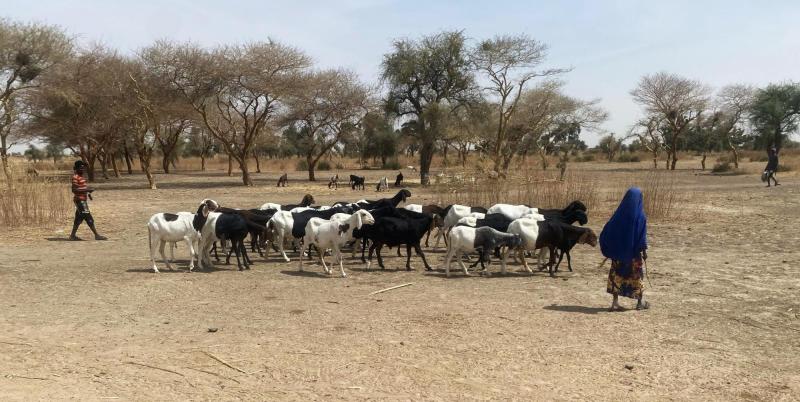
A woman tending to her sheep: one of the new livelihood activities adopted by farming households in Yobe State, Nigeria. Credit: Bilkisu A. Jamo / BOOX Community Ltd
Download
application/pdf
182.09 KBapplication/pdf
590.92 KB