Technical report
Food prices in Mali and Sudan: changes, causes, consequences and responses - May 2025 update
This study builds on earlier SPARC-IDRC research on food prices in Mali and Sudan by looking at subsequent price changes and their drivers, effects, and public responses from 2023 to mid-2025.
Publisher SPARC
From early 2020 prices of cereals, fuels and fertiliser on world prices began to rise, beginning a cycle that would peak in mid-2022, by which time many prices had doubled or more. At the time, much concern was expressed that increases in prices on world markets would transmit to domestic markets in the Global South, driving up local food prices, and causing distress to people on low incomes.
SPARC-IDRC carried out a study in 2023 to see what had happened in Mali and Sudan to staple food prices between 2019 (pre-pandemic) and mid-2022, with what consequences, and with what public responses. That research reported cereal prices in both countries had doubled or more since early 2020. Price rises were (very) largely a result of domestic drivers, above all poor harvests and, in Sudan, hyperinflation. Most people living on low incomes tried to economise by cutting out costly foods and trying to earn more by taking on more work. Public responses were inadequate to mitigate hardship.
This paper extends the analysis in the two countries from 2023 to mid-2025, examining subsequent price changes and their drivers, effects on vulnerable people, and public responses.
Findings
- Prices of cereals had increased greatly since early 2020 in both Mali and Sudan, with Sudanese prices rising by many multiples in an economy experiencing hyperinflation. World prices had only a small influence on domestic prices in Mali and Sudan; most clearly seen since mid-2022 after which world cereals prices fell, while those in Mali and Sudan remained high. In both countries, domestic cereal production per person has fallen markedly over the last five or more years. Harvests faltered: in the face of conflict affecting large parts of both countries, farmers struggled to plant, tend and harvest crops — indeed, hundreds of thousands of farmers had been displaced and no longer worked their original farms — while disruptions to trading reduced the incentive to produce a surplus.
- People on low incomes had to economise on food, eating the cheapest foods and often eating less. They had further cut spending on health care and schooling for their children, with many children removed from school entirely. Assets had been sold, loans taken out. Searching for extra income, people had to take on arduous jobs or very low-paid employment, and sometimes both. Only a few options offered good wages, but these also entailed risks: informal gold mining, migration from rural areas to towns and sometimes leaving the country altogether.
- In areas of (active) conflict in Sudan, the situation had become desperate: in parts of Darfur from 2024 onwards famine was declared, while large areas of the rest of Sudan faced a food emergency.
- Public responses — from government, donors and local and international NGOs — were insufficient to alleviate hardship. Most hard-hit households had to cope with whatever resources they and their close families, friends and neighbours could muster.
Policy implications
Options to prevent food prices rising inordinately in Mali and Sudan include:
- Importing more cereals — surprisingly, given harvest failures, there were few increased imports in either country in years of poor harvests. This is puzzling: domestic prices had risen to levels at which imported grains, even after costly transport to the inland markets of Mali and Sudan, would have been cheaper.
- Holding public stocks to cover harvest losses — but neither country held stocks of sufficient size, but a costly option in any case.
- Controlling prices or subsidising prices of staple foods — the former unfeasible, the latter too costly
- Reducing the incidence and severity of harvest failures — for which there are agricultural development options, but these are difficult to fund and implement when large parts of both countries are conflict zones.
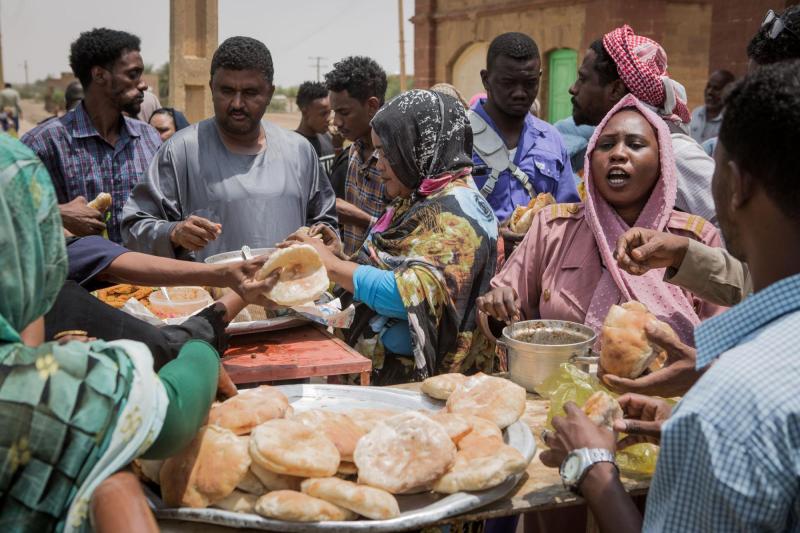
Sudanese passengers buy sandwiches from a woman-owned food stall at Shendi railway station, Sudan
Credit © Sebastian Castelier / Shutterstock
Download
application/pdf
182.05 KBapplication/pdf
2.21 MB