Blog
Reframing aid narratives in protracted crises
To make a real difference in fragile, conflict-affected drylands, the aid sector must drop heroic crisis narratives and refocus on the true actors in the story.
Supporting Pastoralism and Agriculture in Recurrent and Protracted Crises (SPARC) was a research-to-action programme (2020-2025) designed to tackle a very clear problem. Most humanitarian aid is directed to protracted crises: countries experiencing persistent challenges associated with violence and state fragility. Given that global poverty and climate vulnerability are increasingly concentrated in such places, how can aid interventions help people cope better, and even thrive, despite the difficulties they face?
SPARC began by consulting donors, policy makers and researchers to better understand how applied research could make a difference in fragile and conflict-affected (FCAS) drylands. These discussions revealed an interesting pattern.
On the one hand, most observers saw, first and foremost, problems. They spoke of FCAS as places marked by hunger, violence and poverty; of people practising archaic livelihoods without the resources, institutions and agency to make progress. We called this ‘the crisis narrative’.
The same people, however, brimmed with solutions, usually requiring aid interventions to bring about transformational changes. "If we can settle pastoralists as ranchers or irrigating farmers", or "if we can create urban jobs", or "if we can privatise land", then violence and poverty will fall, hunger will vanish, and peace will blossom. We might call this ‘the heroic narrative’.
Why our scepticism?
First, because these narratives contrast so starkly they are practically disconnected. Confronted with crippling crisis, it may be intuitive to seek swift and radical change. But if the situation is so hopeless, how can such transformational change possibly be accomplished and sustained?
Second, the crisis narrative only discusses symptoms, not causes. Symptoms are presented as context. This simplified narrative makes FCAS drylands appear intrinsically and inevitably violent, hungry and poor. Historically, many of these areas were actually prosperous, their residents well-fed and peaceful, but the “what changed?” is rarely discussed.
Third, the lack of nuance. Compared to such simple, black-and-white accounts, reality is both more complex and somewhere in the middle. People in FCAS drylands may not have everything they need and may face challenges which stretch their abilities to cope. But they are not waiting patiently for a hero to save to them. They do have agency, and they use it to make sensible decisions in adapting to problems, taking advantage of opportunities, and improving their lives.
In short, these stories – the persistent crisis and the heroic intervention – are caricatures of a more complex, and more hopeful, reality.
But if these stories are caricatures, why are they so ubiquitous? What purpose do they serve?
One answer is that they help individuals and organisations respond to common incentives in aid agencies:
- Crisis narratives diminish accountability. If the situation is hopeless, one cannot be blamed that the radical approach didn’t work. Indeed, rather than learning from previous failures of idealised, transformative interventions, agencies can claim to have learned lessons to inform the latest attempt at dramatic change.
- It is often easier to convince leaders to raise money for a bold, transformative initiative (that most likely won’t work) than for a routine intervention that will make a small but incremental and reliable difference.
- Some institutional frameworks for channelling aid are underpinned by mainstream policy assumptions which do not align well with the realities of FCAS drylands. But conforming with those assumptions typically secures funding more reliably and quickly than trying to challenge or reform the system.
In other words, these narratives do have a valuable function. However, that is to help aid actors market their ideas and operate within an imperfect aid system rather than to engage productively with the realities of FCAS drylands.
Enough diagnosis. What can be done?
SPARC’s research over the last six years suggests that the first step is to stop. Stop focussing on solutions. Stop looking for silver bullets, transformational approaches, and interventions that work reliably in all contexts. Instead:
Ask better questions. SPARC’s work exploring why context matters, and tracking the medium- to long-term outcomes of investments in resilience, demonstrates how unfounded assumptions can lead to ill-conceived and ineffective interventions. By contrast, the resilience of people and communities in the drylands is largely underpinned by social relationships and shared moral norms, not by the interventions of outsiders. Peace and prosperity in drylands almost always come from incremental, locally-grounded changes that works with the grain of local practices and norms.
Focus on improving delivery. The narrative of crisis and hopelessness not only exaggerates, but also blinds us to practical possibilities, even in sometimes difficult circumstances. SPARC’s work on addressing the conflict blind spot in climate adaptation finance is a good example of what can be achieved when aid partners take pragmatic steps to unblock effective assistance. This may require institutional reforms from donors, such as revising their risk tolerance, making funding more accessible for local organisations, and ensuring that interventions better reflect and support the ways in which communities navigate risk.
Support local agency and empower local actors. Similarly, the heroic narrative exaggerates the capabilities of aid actors while blinding us to the agency, knowledge and resources of others. The people of FCAS drylands are consummate survivors; skilled in managing risks and adapting to them. The most effective solutions will be those aligning with their own aspirations which they build for themselves.
If the aid sector is serious about making a difference in FCAS drylands it must abandon narratives which exaggerate its own agency in a heroic struggle against perpetual and inevitable crisis. Instead it should recognise and support the quiet, persistent work already happening on the ground by the people who are the real actors in the story. In a world of shrinking budgets for ODA, asking better questions, improving delivery and empowering local actors may be more relevant than ever - lowering delivery costs, generating more effective and sustainable impact, and enhancing the integrity of aid itself.
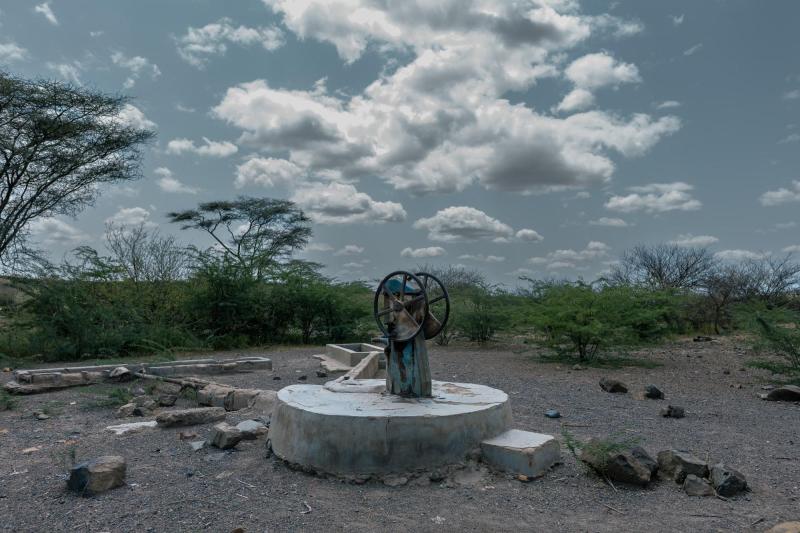
Abandoned borehole in Turkana, Kenya. Credit: Elphas Ngugi / Supporting Pastoralism and Agriculture in Recurrent and Protracted Crises (SPARC)